Just Press No: Three Small Wins for Your Next Cancun Trip
When you use an ATM in your home country, you probably are used to just clicking through the options so fast you don't even think about them. When you're in a foreign country, that can be a mistake.
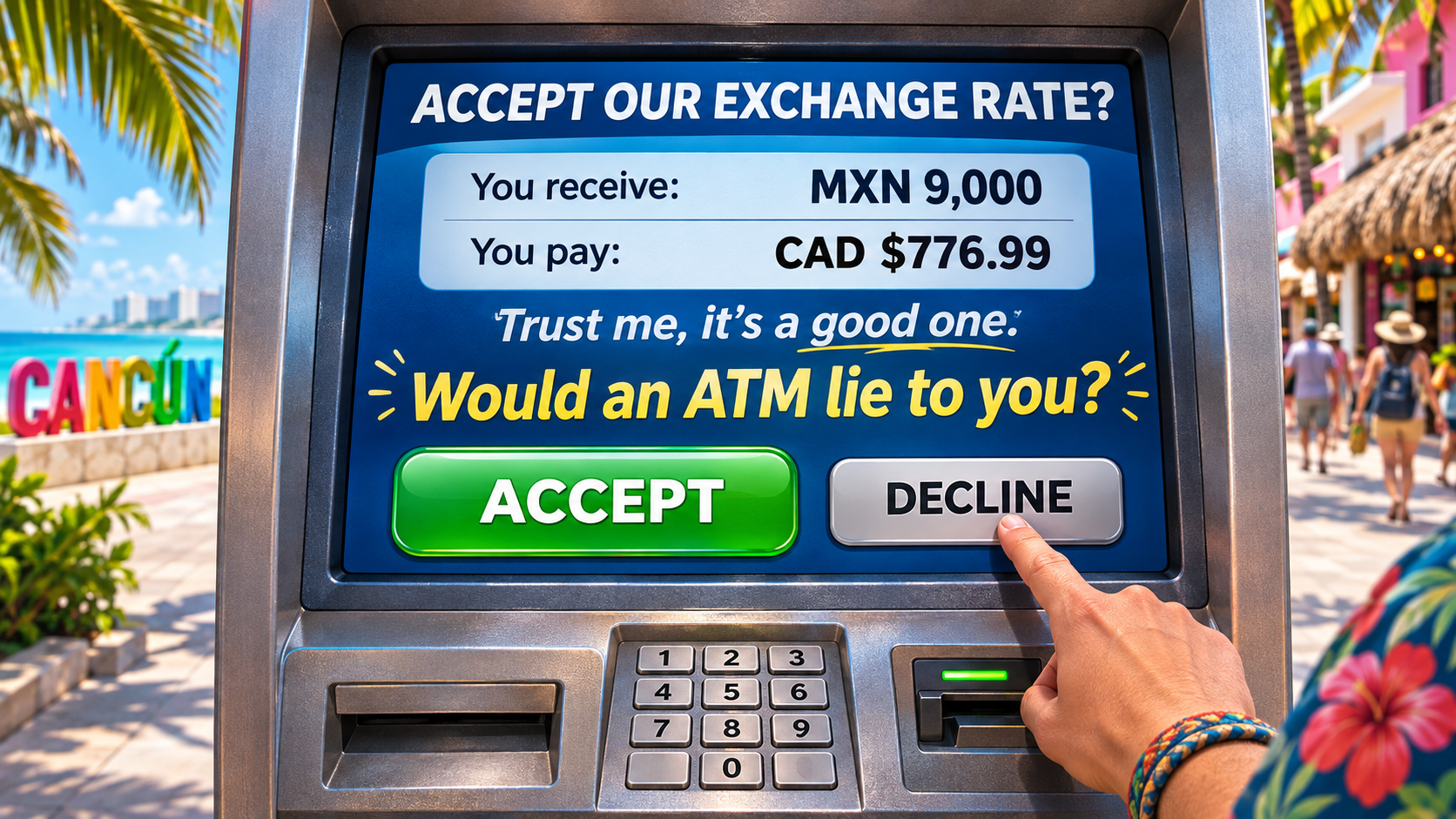
At the ATM yesterday, I was clicking through the options. I'm at Plaza Hollywood in Cancun, across the road from the big Walmart in town, and decided it's time to pull out a little extra cash. I went to a well-known bank, HSBC, and I used their ATM. I put in my card, entered my PIN, started clicking through the options, and then I was given a screen showing the conversion from MXN to CAD. And a simple prompt: "Do you wish to accept the conversion?" The first time I ever did this, I thought if I said no, the transaction would end, so I said yes. Now I know better.
The exchange rate I was being offered for a 9,000-peso withdrawal would have cost me $776.99, but by saying no and letting my Canadian bank do the exchange, it only cost me $711. Just pressing the no button, I saved $66. Now, $66 isn't going to change my life, but it's enough money for me to be happy I said no. If I saw $66 lying on the sidewalk, I would pick it up. In Mexico, you can eat several dinners in decent restaurants and come home with change from $66. There’s a place north of Lopez Portillo with the best turkey tacos and empanadas, and you could pick up the check for several people for less than $66.
Same cash, same machine, same morning. Nearly $66 saved, just for pressing no. And if you spend a lot of time down here - I’m talking to my fellow snowbirds here - over the course of a winter pressing no could save you several hundred dollars.
I’ve been coming to Cancun long enough that I should probably be past the point of being surprised by anything at an ATM. But I like a trick that simple. No app to install, no loyalty program to join, nobody to haggle with. Just a button.
With high season getting underway, here are three small wins for your next trip. None requires a gadget, a spreadsheet, or folding your clothes in a special way. Just knowing what to do when you get there.
1. Just Press No
That ATM offer has a name: dynamic currency conversion. You don’t need to remember it. What matters is that when a machine offers to charge you in your home currency, it’s offering its own conversion rate, usually with a markup.
Decline the conversion and let the withdrawal go through in pesos. Your card network and bank then handle the exchange under your card’s usual terms. In my case, the difference was $65.99. You’re declining the machine’s exchange offer. You still get your cash.
The same choice can appear at a restaurant. The waiter brings the terminal to the table, and it asks whether you’d like to pay in Canadian dollars or pesos. It feels considerate, as though the machine is saving you the math. Pick pesos. Always. I’ve even seen this when shopping in regular stores - “would you like us to put the charge through in dollars?” the helpful sales clerk will ask. No - pesos please. Only pesos.
One distinction matters: declining the conversion is different from declining the ATM’s withdrawal fee. Your bank may charge fees too. Pressing no to the exchange-rate offer doesn’t make those disappear. And by the way, sometimes the ATM withdrawal fee can be ridiculous. I stopped at one machine the other day, and it wanted to charge me 174 pesos to withdraw money. That's close to $15 Canadian. The HSBC machine charged me 34 pesos. It's not hard to guess why I went to the second machine.
I also prefer a bank ATM inside a branch or mall*. And if I’m spending pesos, I withdraw pesos. Taking out US dollars only to exchange them again adds another step - and another opportunity to lose money on the rate. On TripAdvisor and Reddit, you'll hear people insisting that the locals prefer U.S. dollars for tips. I'm here to tell you that's absolute nonsense. I've watched the waitress from an all-inclusive resort lining up at a currency exchange counter to convert the USD to Pesos. The staff at the resort will never tell you “I wish you brought pesos” - they are grateful for any tips. But every store they spend at will give them a terrible exchange rate on USD. So instead of getting a stack of US one-dollar bills, ask you bank to bring in a stack of 50 pesos bills. (And yes, I know 50 pesos isn’t $1 USD - I’m subtly encouraging people to tip better!)
I understand that it's easier to bring currency from your home country. If you're from anywhere other than the U.S., do not exchange your money for U.S. dollars to go to Mexico. For Americans who want to save a step, fine, I get it, but the rest of us should be converting our money to pesos.
2. Put Your Bag Behind You
Cancun’s Terminals 3 and 4 have automatic immigration gates. Eligible Canadian and American tourists can use them, along with travellers from several other countries. Some worry about the eligibility, but all you're looking for is a little symbol on the outside of your passport that shows that it's got a chip in it. If you're from Canada or the U.S. and your passport is valid, it almost certainly has the chip. Feel free to use the e-gates if the immigration official allows.
The published requirements include being over 18, travelling without minors, and carrying an ordinary biometric passport with at least 180 days of validity remaining. Mexican temporary and permanent residents should use the staffed immigration booths instead.
I used the gates for a few seasons before I had residency, and I learned one small thing that made them much less frustrating.
If you’re pulling a carry-on, keep it behind you as you enter.
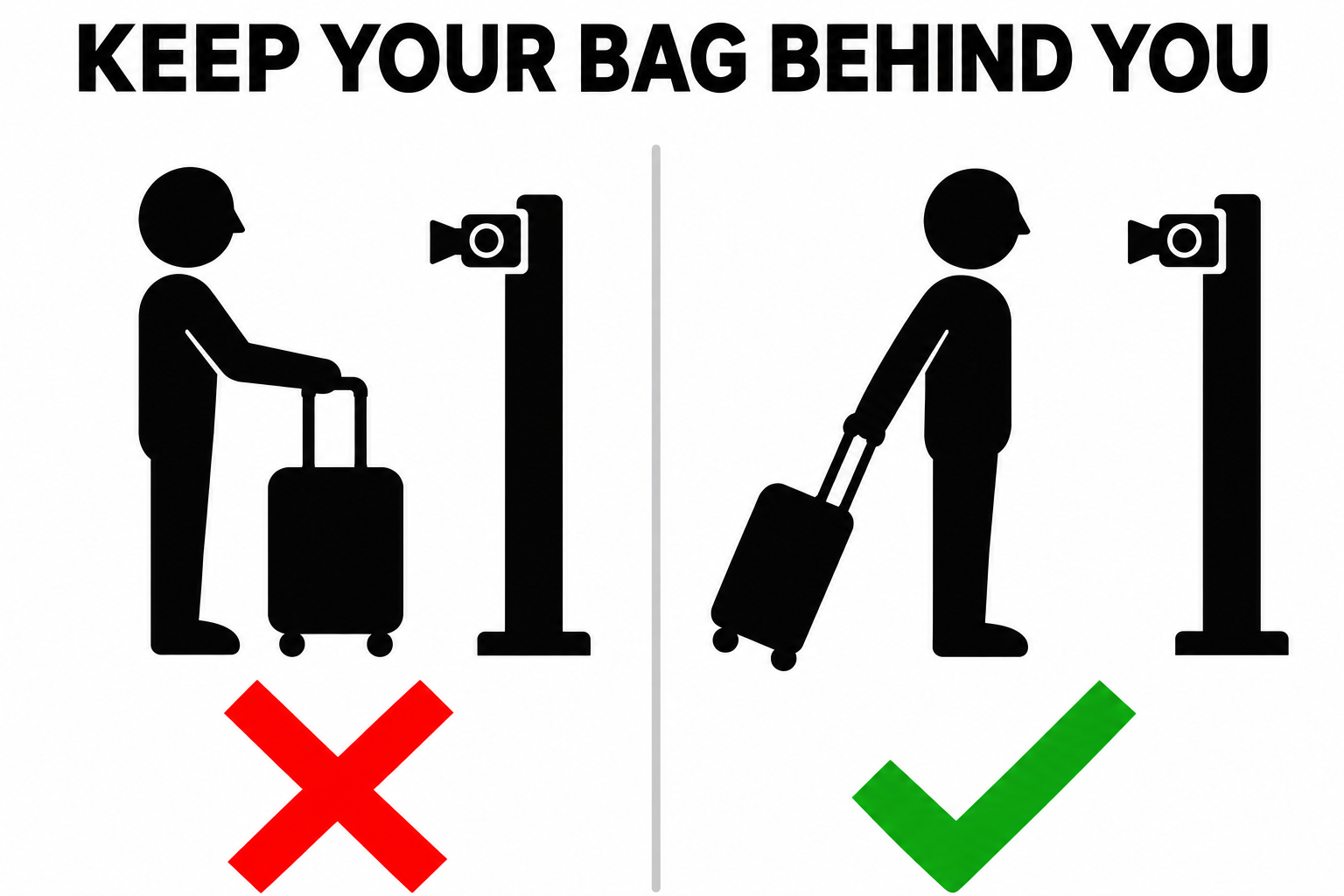
this sign should seriously be on the front of all the eGate machines, but it isn't.
I’ve watched people push their suitcase into the gate first, then stand there scanning their passport again and again while nothing happens. I’ve been told that the bag confuses the sensors, as though a second person is trying to come through.
Whatever the machine thinks it’s seeing, pulling my bag behind me worked much better. Scan your passport, wait for the entrance to open, then step in facing forward with your suitcase following you. Follow the camera prompts and any instructions from staff.
When you’re through, collect the printed ticket. Scan its QR code to download your digital immigration record, and keep both until you leave Mexico.
I'm not saying this is good industrial design or that it should work that way. I'm just saying it does. Every time I've seen people put their suitcases in front of them, the machine does not let them through, and they end up waiting in line to talk to a human. But when they pull the suitcase in behind them, it works like a charm. And if that doesn't work, then move the suitcase in front of you. Just know that the suitcase location seems to somehow trigger the scanner. I’m not going to pretend it's 100% consistent. Nothing in Mexico ever seems to be, but this seems to be the trick that gets people through the e-gates quickly.
And for those of you with temporary or permanent residency, here's another little hint. The much shorter line for Mexican citizens literally says on the sign, "No residentes." So I always assumed that as a temporary resident I couldn’t use that line.
Try this: when you get off the plane, show the immigration official who's directing people your residency card, and nine times out of ten, he's going to channel you into the line for Mexicans. If you have carry-on baggage only, you'll be leaving the airport before most people on your plane have even spokes to a customs official.
3. Give Duty-Free a Second Look
I’ve walked past the arrivals duty-free in Cancun with my mind already at the beach - or at least at baggage claim. Depending on which terminal you're going through and the time of day, there's a good chance you'll come across an open duty-free liquor store.
It can be worth a look. Just go in with the right expectations.
“Duty-free” isn’t a promise that something is cheap. For an ordinary bottle of tequila or rum for the condo, I’d compare prices at La Europea or Walmart before assuming the airport has a bargain. And buying before customs doesn’t give you an extra alcohol allowance.
So why stop?
Because travel-retail shops sometimes carry bottles you won’t routinely see at your local liquor store. My favourite example is Hendrick’s Amazonia, a tropical variation on Hendrick’s gin that was launched as a travel-retail exclusive. We first discovered it in Toronto’s Duty Free store on arriving back in Canada. But what if you want a bottle in Cancun, something to share with friends?
I can’t guarantee it will be on the shelf every time, or that a bottle originally sold as an exclusive can never turn up elsewhere. But it’s a good reason to spend a few minutes browsing. I have never seen Amazonia outside of a duty-free store. We've looked. My wife loves it, but the only chance to get it is at duty-free. And it can be a great little gift idea if you're visiting friends in Mexico.
If you’re headed to an all-inclusive, you probably have your drinks covered. If you’re staying in a condo or rental, one unusual bottle might be a nice addition to the trip.
For me, that’s the appeal: finding something interesting while I’m already passing through.
The Small Stuff
I like big travel moments: the first swim of the season, the reef off Cozumel, a sunset that makes everyone at the table stop talking. But I’ve come to appreciate the small stuff too. The little decisions that quietly make a trip easier.
An exchange offer you declined. A bag you pulled behind you. A quick stop that turned up something you wouldn’t normally find. None of it will make the photo album. But nearly $66 Canadian buys a very nice dinner in Cancun, and the gate opening on the first try is its own little welcome.
So this season, when the ATM asks you that polite question about converting your money, you’ll know what to do. The lesson all us Gen-Xers had drilled into our heads as children:
Just press no.
*Footnote story - Preferring ATMs in malls or banks is a common piece of advice to help avoid fraud or possibly even robbery, but here's the weird thing. At one ATM in the Soriana Mega store, I was actually offered insurance for my money in case it was lost or stolen. I don't know how someone would ever make a claim on this, or if the robbery scenario is so frequent that it's actually worth buying insurance in case you're robbed.